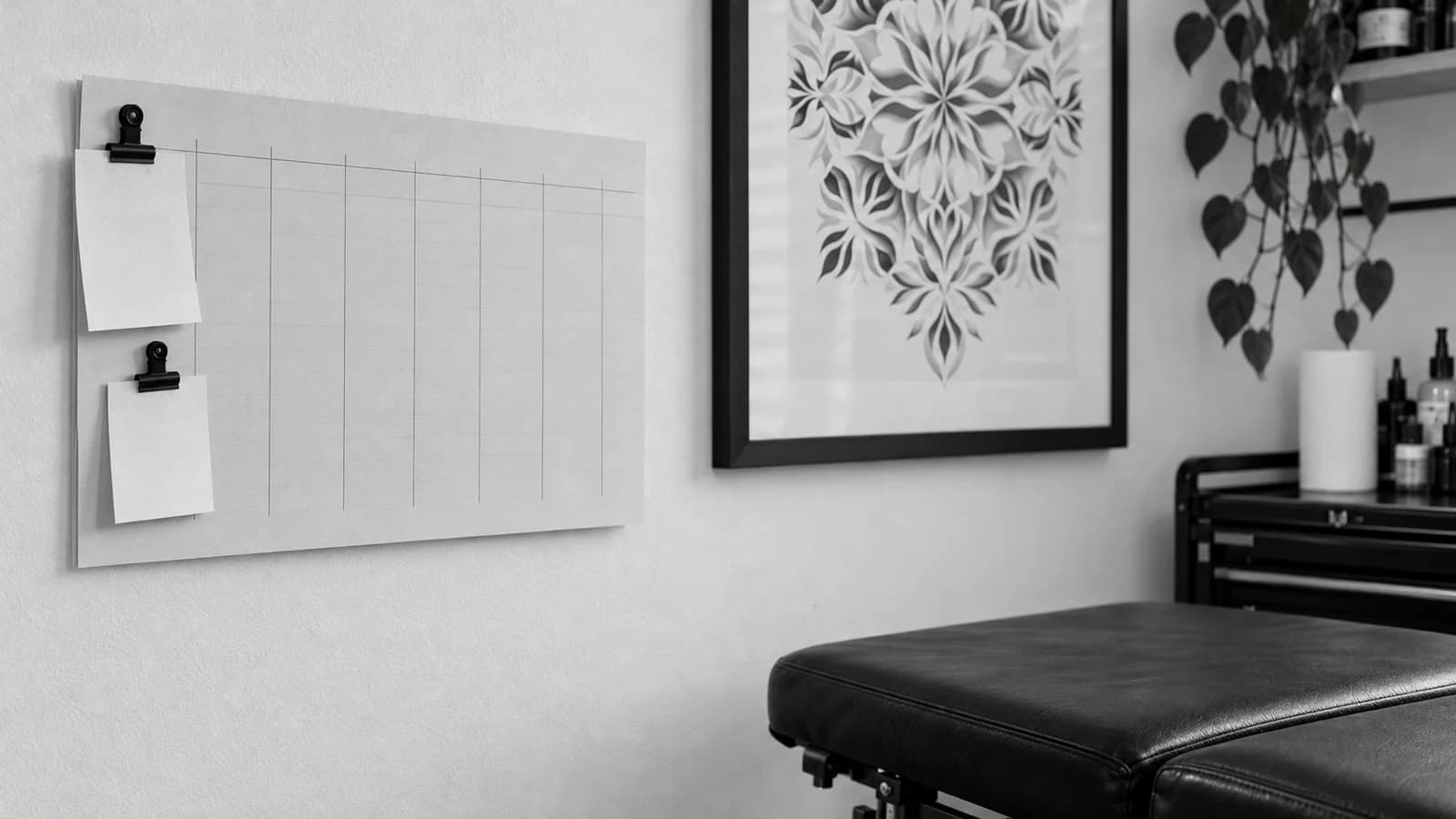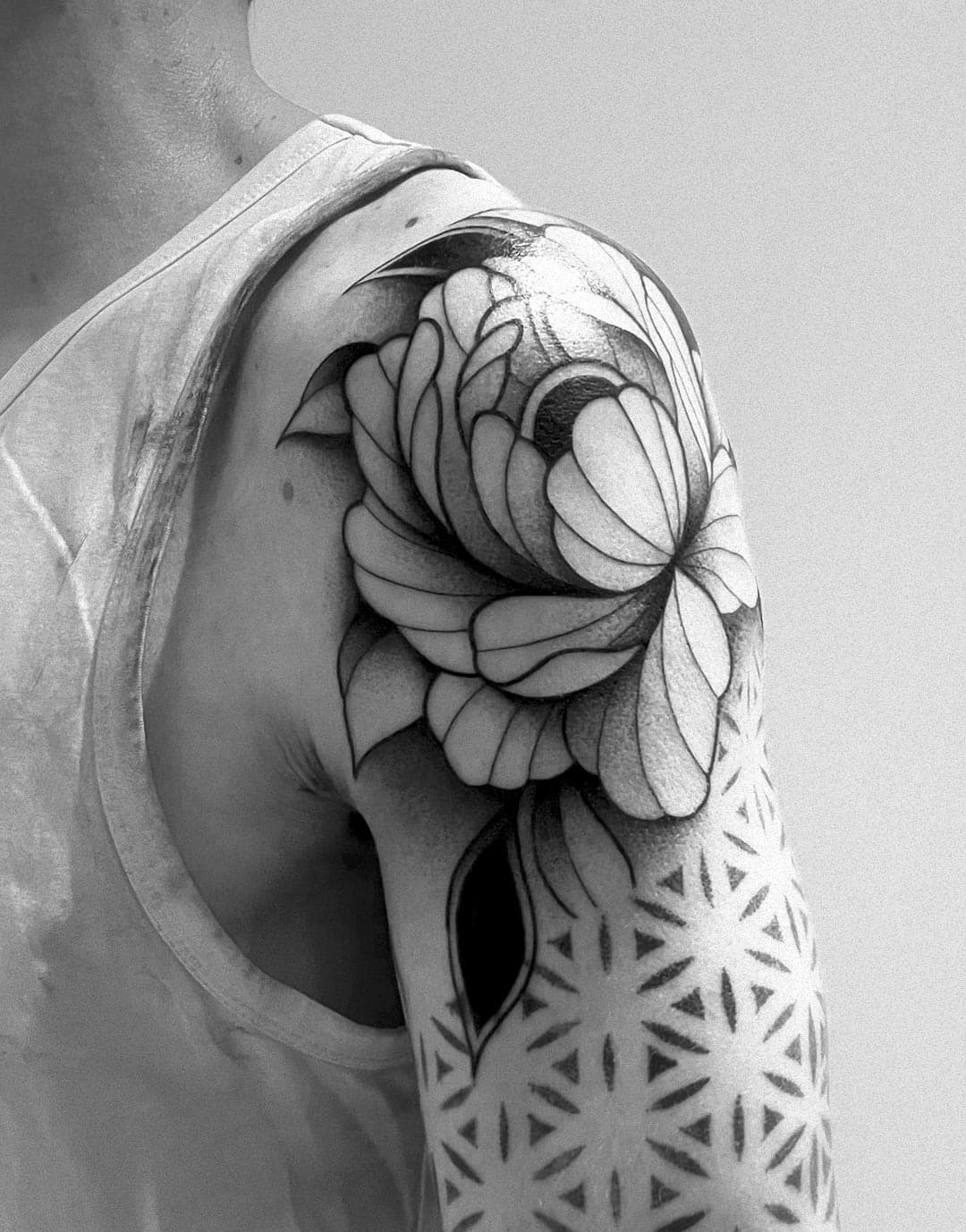
Photo: Romain Noiry / RamOne Tattoo.
A tattoo artist website has two jobs
First, show enough of your work that the right client recognises their project in it, and the wrong one moves on. Second, turn “how much for a small one?” into an enquiry you can answer in one message. Everything else on the site, from hours to aftercare, supports one of those two jobs or saves you a DM.
A portfolio that loads on a phone
Pick the pieces you want more of, rather than everything you have ever tattooed. Add healed photos as well as fresh ones, so clients see how your work settles. If you do several styles, group them so a lettering client does not scroll through forty realism pieces first.
Then check the weight. Google’s web.dev guidance counts a page as fast when its largest image or text block appears within 2.5 seconds for three visits in four, measured on phones and computers separately (Largest Contentful Paint). Full-size camera files make that hard on mobile data. Export pictures at screen size, and give each one a short description: Google uses alt text, file names and nearby text to understand an image (image SEO best practices). “Black and grey peony on a shoulder” helps; “IMG_4032” does not.
An enquiry form that asks what you need to answer
A form beats an e-mail address because it asks the questions for you. Ask for the few answers that tell you whether to propose a date, a consultation or a polite no:
- Type of project: custom, flash or cover-up
- Placement on the body
- Approximate size, in centimetres, inches or “the size of my palm”
- Reference images, with a limit on how many
- A first name and a phone number or e-mail you can reply to
- Date of birth, if you check age before you book
Say what happens after they press send, and how long you take to reply. RamOne’s form opens with Romain’s own line, in French: describe your project, I reply quickly, usually within 48 hours. One sentence, and the client knows when to expect an answer.
Deposits and booking policy, written down once
Put the rules on the site before anyone asks: how much the deposit is, whether it comes off the final price, how much notice you need to move a session, when a deposit is kept, and whether you tattoo minors. Clients read it before paying; you link to it instead of retyping it. The deposit policy guide has wording to start from.
Aftercare, FAQ and gift cards
An aftercare page is something a client can reopen on day three, when the paper sheet has gone in the bin. The aftercare instructions template is a starting point. A short FAQ answers what keeps landing in your DMs: walk-ins or not, minimum price, cover-ups, how long a session lasts.
Selling gift cards on the site means taking payment, sending the card and keeping track of its code until it is used. Check the expiry rules where you work before you print a date: in the United States, federal rules generally require gift cards to stay valid at least five years from sale, with exceptions (12 CFR 1005.20). The gift card guide covers amounts and redemption.
Where you are, when you are open, and Google
Give the address, how to get in if the studio is private or upstairs, and your hours. Then make your Google Business Profile say the same thing. The profile has its own website field, hours and special hours for holidays and other temporary changes (Edit your Business Profile).
Google ranks local results on relevance, distance and prominence. To help, its own help page asks for a complete profile, accurate hours, verification and replies to reviews; prominence includes reviews and links from other websites (Tips to improve your local ranking). A website does not replace the profile. It gives the profile somewhere to send people, and the link in your Instagram bio a better destination than a list of DMs.
What to leave out
- A price list for custom work. You would be quoting before seeing the placement or size; give a minimum and explain how you price instead (tattoo pricing).
- A “Book now” calendar if you actually decide dates after talking. Clients pick a slot, then you cancel it.
- A blog or news page you will not update. A last post from two years ago reads as a closed studio.
- Intro animations, autoplay music and pop-ups on the first visit. They stand between a phone and your portfolio.
- Photos of anyone else’s work, and stock tattoo pictures.
Four ways to get a tattoo artist website
| Option | What you get | What it costs you | Watch for |
|---|---|---|---|
| Instagram only | Your feed and DMs, no setup | Nothing to pay | No form: placement, size and references arrive scattered across DMs |
| Website builder (Squarespace, Wix, WordPress) | Your own domain and full control of the layout | A monthly plan, plus your evenings | The form, payments and gift cards are yours to add and keep working |
| Web agency | A designed site, built for you | A quote, then changes on request | Who updates the gallery every month |
| Mini-site that comes with studio software | Pages filled from the tool you already use | Included in the subscription, or a paid option | The software’s address and layout, and how its form or booking fits your work |
Several studio tools include a booking page; the tattoo booking software comparison lists how clients book with each. If you already pay for a builder, keep it, and check what the studio software can plug into it.
The needlz mini-site, as it works today
Each studio on needlz gets a site at its own address on needlz.app, set up from the app on the iPhone. The home shows a cover picture, your latest posts, your address, hours and contact, and your Google rating once the studio is linked to its Google listing; each part can be switched off. The gallery can copy your new Instagram and TikTok posts every night, and you can add photos or hide any picture. The aftercare and FAQ pages are yours to write; the app offers a starting text you can edit. The site shows its own buttons and menus in the visitor’s language: English, French, Spanish, German or Italian.
The project form asks for the type of project, placement, approximate size, the idea, up to five reference images, and a date of birth if you switch that field on. The request arrives in the app; you reply by text or e-mail from your own phone, set the date, and send the deposit link the app drafts, paid through your own Stripe account. Gift cards are paid by card through the same account and sent by e-mail or printed. If you already have a website, the app gives you a button to paste on it that opens your form or gift card page.
The mini-site is part of the needlz subscription, with no extra fee: €19 a month or €190 a year for the first 100 studios, then €29 or €290, after a 30-day trial without a card. Prices are in euros including VAT; outside the euro area the App Store shows them in your currency (pricing). The app is on the App Store for iPhone since 10 November 2026; Android is coming.
RamOne’s mini-site is a live example, from a cofounder’s studio: gallery, aftercare, FAQ, gift cards and the form shown below.
Frequently asked questions
Does a tattoo artist need a website if they have Instagram?
You can be found without one, on Instagram and Google. A site earns its place when it saves you work: an enquiry form that asks for placement, size and references, your deposit rules, aftercare and hours, all at one link you can put in your bio and on your Google profile.
Can clients book a slot on the needlz mini-site?
No. They send a project request with their references. You reply from your phone, agree the date, and send the deposit link. If most of your work is flash on fixed slots, a tool with self-service booking may suit you better.
Can I use my own domain name?
Not today. The mini-site lives at yourstudio.needlz.app. You can point a link or a button from your own domain or existing site to it.
Does the mini-site cost extra?
No. It is included in the needlz subscription, with a 30-day free trial without a card. Stripe’s fees apply to deposits and gift cards paid online; needlz takes no commission.
Sources
- Google Business Profile Help: Tips to improve your local ranking on Google
- Google Business Profile Help: Edit your Business Profile
- Google Search Central: Image SEO best practices
- web.dev: Largest Contentful Paint (LCP)
- 12 CFR § 1005.20, Requirements for gift cards and gift certificates — Cornell LII
- RamOne Tattoo’s needlz mini-site (a cofounder’s studio)
- needlz pricing
- needlz features and availability